



Picking a face mask shouldn't be hard. But many people get confused. Should you grab a 3-ply mask or spend more on a KN95 mask?
Let's break it down in simple terms.
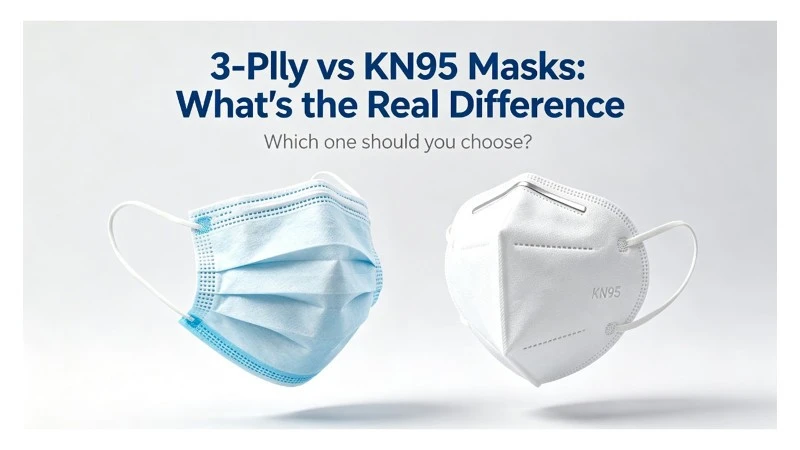
Understanding 3-Ply Masks
A 3-ply mask has three layers of material. You've seen these everywhere - doctors wear them, stores sell them cheap, and kids use them at school.
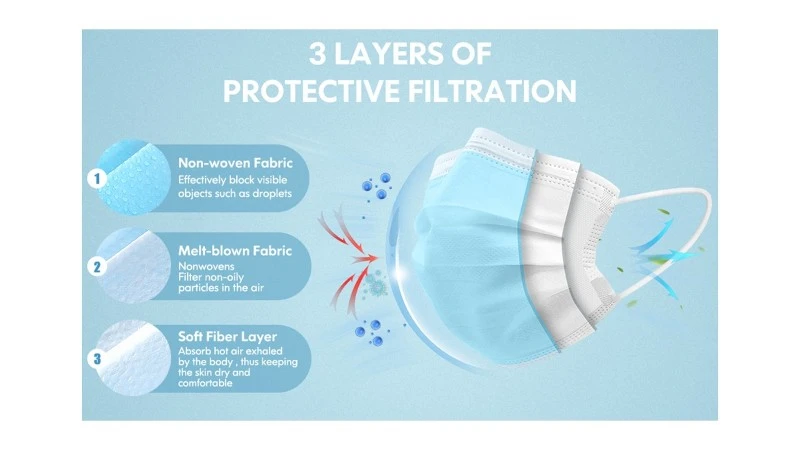
What Are the Three Layers?
Think of it like a sandwich:
- Top layer: Stops water and big droplets from getting in
- Middle layer: This is the filter that catches particles
- Bottom layer: Soft material that touches your face and soaks up moisture
These masks use polypropylene material. It's a plastic fiber that's light and breathable. The nonwoven fabric lets air move through pretty easily.
How Does It Work?
Air flows through the fabric, and particles get caught in the fibers. Pretty simple, right?
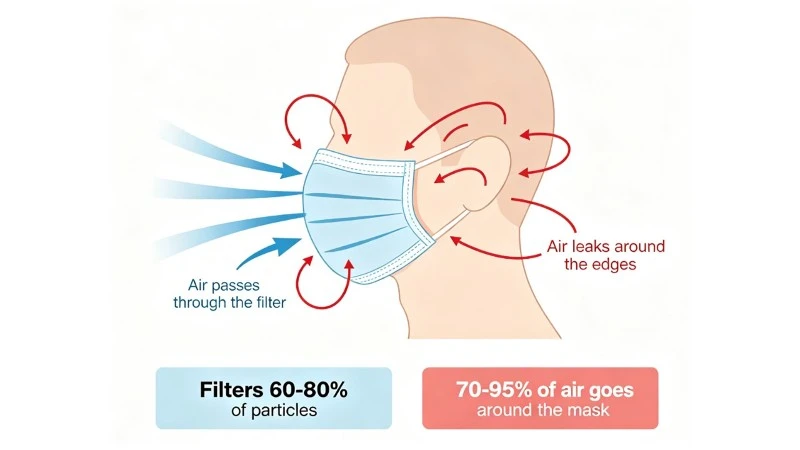
But here's the catch: These masks fit loose on your face. They have ear loops and a thin nose wire. Because the fit is loose, lots of air sneaks around the edges instead of going through the filter.
Studies show these masks filter 60-80% of particles. Sounds good! But wait - about 70-95% of the air you breathe actually goes around the mask, not through it. That's a big problem.
Understanding KN95 Masks
A KN95 mask is totally different. It's called a respirator mask. The goal is to create a seal on your face so all air must pass through the filter.
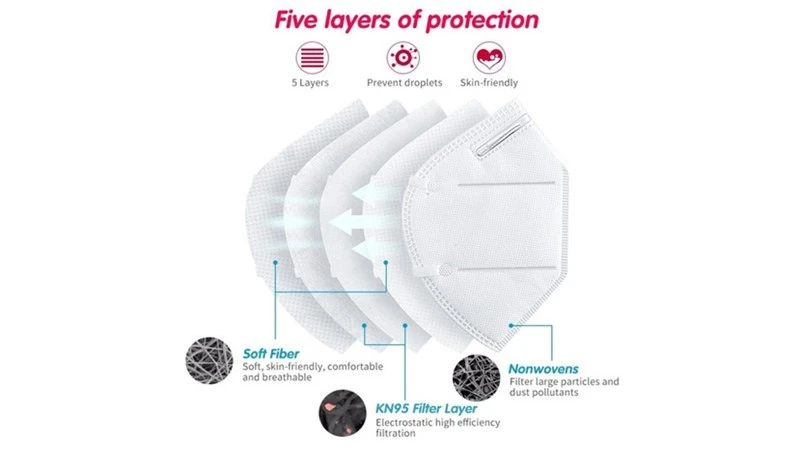
Five Layers of Protection
These masks usually have five layers working together:
- Outside layer stops big stuff
- Support layer adds strength
- Main filter with special electrostatic charge
- Another support layer
- Inside comfort layer
The Technology Behind It
KN95 masks don't just block particles. They use electrostatic filtration - the fibers have an electric charge that pulls particles in like a magnet attracts metal.
Plus, the tight seal around your face means air can't escape around the edges. Everything you breathe goes through those filter layers.
The numbers tell the story: KN95 masks catch 95% or more of particles, even super tiny ones at 0.3 microns in size.
Side-by-Side Comparison
Here's what you need to know:
|
What You're Comparing |
3-Ply Mask |
KN95 Mask |
|
How well it filters |
60-80% |
95%+ |
|
How it fits |
Loose and gapped |
Tight seal |
|
Layer count |
3 |
4-5 |
|
Material weight |
25-45 GSM |
50-80 GSM |
|
Easy to breathe? |
Yes, very easy |
No, takes effort |
|
How comfortable? |
7.5-8.5 score |
5.5-6.8 score |
|
Price each |
$0.10-$1.00 |
$0.50-$3.00 |
|
Can you reuse it? |
No |
Yes, many times |
Real Protection Numbers
Let's talk about what actually matters - does it stop particles?
Big droplets (the ones you see when someone sneezes):
- 3-ply: blocks 85-96%
- KN95: blocks 95-99%
Small floating particles in the air:
- 3-ply: blocks 50-70%
- KN95: blocks 90-98%
Tiny particles you can't even see:
- 3-ply: blocks 40-60%
- KN95: blocks 95-99%
The difference gets bigger as particles get smaller.
Why Fit Matters So Much
Here's something most people don't know: how the mask fits your face matters MORE than the filter itself.
With a loose-fitting 3-ply mask, research found 96.44% of particles can leak in through the gaps. Yes, you read that right - 96%!
A good KN95 with a tight fit only has 5-20% leakage. That's why the seal is everything.

Comfort Level
3-ply masks win for comfort:
- Breathing feels normal
- Lightweight feel
- Face stays cooler
- Talking is easy
- You can wear it 8+ hours without problems
KN95 masks are tougher to wear:
- Breathing takes more effort
- Feels heavier
- Face gets hot (about 2-3°C warmer)
- Harder to speak clearly
- Gets uncomfortable after a few hours
When Should You Use Each One?
Go With 3-Ply Masks When:
✓ You're doing everyday activities ✓ Working in an office with windows open ✓ Quick shopping trips ✓ Outdoor gatherings ✓ At school ✓ Wearing a mask for the whole workday ✓ Comfort is your top priority
Go With KN95 Masks When:
✓ You're in healthcare settings ✓ Crowded places like buses or airports ✓ Around sick people ✓ Your job is high-risk ✓ You have health problems ✓ Close contact with many people ✓ You absolutely need the best protection

What About the Cost?
KN95 masks cost more upfront. But you can use them multiple times:
3-ply masks:
- Price: $0.10-$1.00 per mask
- Throw away after one use
- One week (7 masks): $0.70-$7.00
KN95 masks:
- Price: $0.50-$3.00 per mask
- Reuse 5-20 times
- Per use: $0.10-$0.60
- One week (2-3 masks): $2.50-$9.00
With reuse, KN95 masks might actually save you money over time.
How Long They Last
|
Timing |
3-Ply Mask |
KN95 Mask |
|
One wearing |
4-8 hours |
8-12 hours |
|
Total lifetime |
Use once |
8-40 hours |
|
Times you can wear it |
1 |
5-20 |
Throw your mask away when:
- It gets wet
- You see tears or damage
- Straps break
- It looks dirty
- Breathing gets difficult
Watch Out for Bad Quality
Not every mask works like it should. This is especially true for KN95 masks.
Big problem: Research shows 20-60% of KN95 masks for sale don't actually filter 95%. Some only filter 49-67%. That's barely better than a 3-ply mask!
How to Spot Good Masks
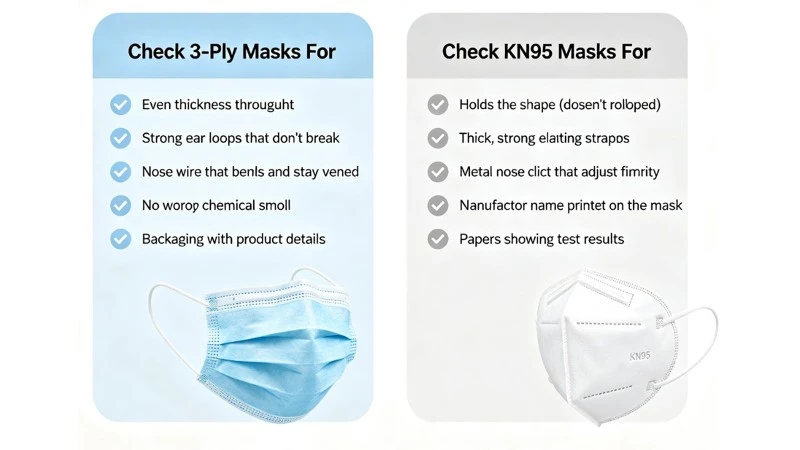
Check 3-ply masks for:
- Even thickness throughout
- Strong ear loops that don't break
- Nose wire that bends and stays bent
- No weird chemical smell
- Packaging with product details
Check KN95 masks for:
- Holds its shape (doesn't collapse)
- Thick, strong elastic straps
- Metal nose clip that adjusts firmly
- Manufacturer name printed on the mask
- Papers showing test results
Wearing Them the Right Way
Steps for 3-Ply Masks:
- Colored side goes outward
- Pinch nose wire to fit your nose
- Stretch down to cover your chin completely
- Cover both nose and mouth
- Don't touch the front part
Steps for KN95 Masks:
- Shave your face first (facial hair ruins the seal)
- Position over nose and under chin
- Squeeze nose clip firmly
- Feel around edges for air leaks
- Test the seal: breathe in hard and mask should stick to face
Deciding What to Buy
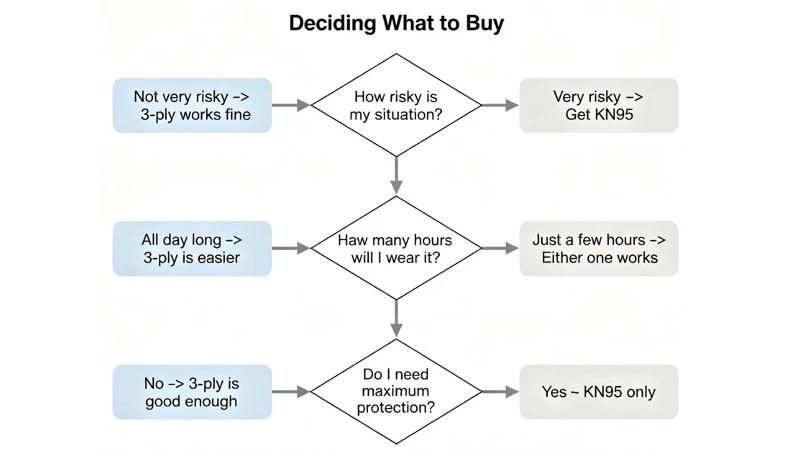
Think about these questions:
How risky is my situation?
- Not very risky → 3-ply works fine
- Very risky → Get KN95
How many hours will I wear it?
- All day long → 3-ply is easier
- Just a few hours → Either one works
What can I spend?
- Tight budget → Start with 3-ply
- Can spend more → Buy both types
Do I absolutely need maximum protection?
- Yes → KN95 only
- No → 3-ply is good enough
Tips for Bulk Buyers
Buying for your business or organization? Remember these points:
✓ Get samples first - test before buying thousands ✓ Ask sellers for test reports ✓ Check who actually made the masks ✓ Calculate your weekly needs ✓ Think about storage (masks last 2-5 years) ✓ Add up total costs including delivery ✓ Consider if people will actually wear them comfortably
Final Thoughts
There's no "best" mask for everyone. It depends on your situation.
3-ply masks work great for regular daily life. They're cheap, comfortable, and easy to wear for hours. They stop you from spreading germs to others and give you basic protection too.
KN95 masks are the serious option. Much better filtering. Much better seal. Use them when the situation is actually dangerous or you're around lots of people indoors.
Smart people keep both types around. Use 3-ply for normal days. Save KN95 for higher-risk situations.
One last thing: wearing ANY mask beats wearing nothing. The best mask is whichever one you'll actually use correctly every time.
Don't overthink it. Match the mask to what you're doing. Stay safe out there.


